

Advisor: Lucinda MacKethan, Professor Emerita, Department of English, North Carolina State University, National Humanities Center Fellow.
© 2011 National Humanities Center
Lesson Contents
How did the cult of domesticity oppress and empower women in the nineteenth century?
Understanding
Nineteenth-century, middle-class American women saw their behavior regulated by a social system known today as the cult of domesticity, which was designed to limit their sphere of influence to home and family. Yet within this space, they developed networks and modes of expression that allowed them to speak out on the major moral questions facing the nation.
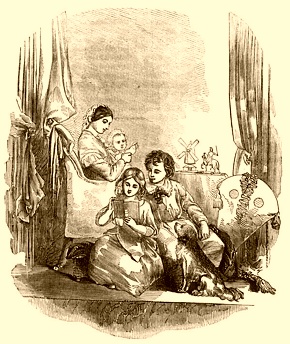
“The Sphere of a Woman,” illustration in Godey’s Lady’s Book, March 1850
Texts
- Fanny Fern, “How Husbands May Rule,” short story, 1853
- Catherine Beecher, “Peculiar Responsibilities of American Women,” essay, 1842
- Harriet Beecher Stowe, Uncle Tom’s Cabin, novel, 1852 (excerpt)
- Harriet Jacobs, Incidents in the Life of a Slave Girl, narrative/memoir, 1860 (excerpt)
Text Type and Complexity
- Fern, “How Husbands May Rule” — literary fiction, gr. 4-5 complexity band.
- Beecher, “Peculiar Responsibilities” — informational text, gr. 11-CCR complexity band.
- Stowe, Uncle Tom’s Cabin — literary fiction, gr. 9-10 complexity band.
- Jacobs, Incidents — literary nonfiction, gr. 6-8 complexity band.
Tier 2 vocabulary words are defined in pop-ups (full list at bottom of page). Tier 3 words are explained in brackets.
For more information on text complexity see these resources from achievethecore.org.
Click here for standards and skills for this lesson.
Common Core State Standards
- ELA-LITERACY.R.11-12.6 (Determine an author’s point of view or purpose…)
Advanced Placement US History
- Key Concept 4.2 (II-C) (Gender and family roles changed in response to the market revolution…)
Teacher’s Note
In each of the passages presented here, at least two of the four principles of the cult of domesticity (piety, purity, submissiveness, domesticity) are illustrated, either positively or negatively, and these illustrations can be compared and contrasted. While the four passages have other features in common, they also voice distinctive, even opposing views. One theme to note is the emphasis on the kinds of trade-off that take place within this cult, meaning that women might very well willingly choose to accept the “rule” of wise husbands and political leaders in return for security, material comfort, and protection. “How Husbands May Rule” and “Peculiar Responsibilities of American Women” stress what women gain by acquiescing to men’s authority. The stories of Fanny Fern and Harriet Beecher Stowe demonstrate differences in how men and women use language and also some interesting patterns in how they shift ground in dialogue with one another. Harriet Jacobs offers a particularly astute use of pious, “domestic” language operating in stark contrast to other statements where she adopts a much more strident emphasis that can be compared to Mrs. Bird’s shifts in tone. Use the Follow-Up Assignment to explore the factors with your students.
This lesson is divided into two parts, both accessible below, and includes close reading questions and an optional followup assignment. The teacher’s guide includes the background note, the text analysis with responses to the close reading questions, and the followup assignment. The student version, an interactive PDF, contains all of the above except the responses to the close reading questions and the follow-up assignment.
Teacher’s Guide (continues below)
|
Student Version (click to open)
|
Background
Contextualizing Questions
- What kind of texts are we dealing with?
- When were they written?
- Who wrote them?
- For what audience were they intended?
- For what purpose were they written?
The period of 1820 to 1860 saw the rise in America of an ideology of feminine behavior and an ideal of womanliness that has come to be known as the “Cult of True Womanhood” or “Cult of Domesticity.” The features of this code, which provided social regulations for middle-class families with newly acquired wealth and leisure, were defined by historian Barbara Welter in an influential 1966 article, “The Cult of True Womanhood: 1820–1860.” According to Welter, “true womanhood” held that women were designed exclusively for the roles of wife and mother and were expected to cultivate Piety, Purity, Submissiveness, and Domesticity in all their relations. Also exclusive was their “sphere,” or domain of influence, which was confined completely to the home. Thus the Cult of Domesticity “privatized” women’s options for work, for education, for voicing opinions, or for supporting reform. Arguments of biological inferiority led to pronouncements that women were incapable of effectively participating in the realms of politics, commerce, or public service. In return for a husband’s provision of security and protection, which by physical nature she required, the true woman would take on the obligations of housekeeping, raising good children, and making her family’s home a haven of health, happiness, and virtue. All society would benefit from her performance of these sacred domestic duties.
Barbara Welter drew on the methodology that social historian Betty Friedan developed for her influential study of American women’s lives in the 1930s through the 1950s. The Feminine Mystique (1963) analyzed popular fiction and women’s magazines, housekeeping manuals, and advertisements to decry messages that encouraged mid-twentieth-century American women to stay home while men took care of business. Welter drew on similar sources for her article on the social constraints placed on women’s lives a century earlier. Both Friedan and Welter’s use of such materials demonstrates how the “Cult” or “Mystique” that sought to regulate women’s behavior were spread by powerful marketing strategies. By the mid-nineteenth century, a vision of women’s high, holy, and only position — in the home — was promoted in the pages of women’s magazines such as Godey’s Lady’s Book (started 1830), the advice of “good housekeeping” handbooks, the texts of sermons, and lectures, and even speeches in legislatures.
The Cult of Domesticity was designed for the wives and daughters of the men who made up America’s white, middle and upper class power structure. Men in this position, with stable incomes, came to rank one another according to the quality of their homes and family life, noticeable mostly in urban areas where proper, well-schooled wives became essential status symbols. During the same period, however, many women, married and unmarried, did not have the means to make a home, nor the kind of protection that would permit them to be sexually “pure.” Free women forced into “unseemly” work to provide necessities and, of course, enslaved women throughout the South, were consigned to the status of “fallen” and were often discounted as immoral, undeserving, fatally flawed.
Certainly many privileged women chafed against the restrictions placed on them by the Cult of Domesticity, while others found within its boundaries some outlets for action and confidence-building, particularly through its emphasis on their duty to educate children and serve others. Women who were becoming successful in writing for the ladies’ markets discovered not only their own personal voices but sometimes a platform for views on public issues. While the women’s suffrage movement did not gain sufficient traction for many more decades, women who wrote in sanctioned publications or joined acceptable women’s and church societies began to make a difference — in the abolition movement, in the fight for property rights, and in women’s education.
The four women whose works are represented in the following lessons benefitted, in some ways ironically, from the domestic ideology that put them into a separate sphere from men. Communities of women, exalted in the home, used the superiority granted them in kitchen and drawing room to call for moral courage from men in the public realm. As opportunities for expression increased, even within their limited space, women developed a language, a kind of domesticated vocabulary of reform, through which they could reach and support one another. Catherine Beecher and Harriet Beecher Stowe, sisters whose father and brothers were influential churchmen and public leaders, taught together in a school for girls, and through writing made their way into public debates over slavery and women’s place. Sara Payson Willis, who wrote popular newspaper columns as “Fanny Fern,” knew the fugitive slave writer Harriet Jacobs well, and Jacobs, who also wrote letters to newspapers and ran an abolitionist reading room, corresponded with Harriet Beecher Stowe. What we call today the power of “networking” was augmented by the Cult of Domesticity, resulting in unforeseen challenges to the system’s restrictions. From inside their separate sphere, these four, as well as many other women writers of antebellum America, became a force to be reckoned with in the nation’s largest moral debates.
Text Analysis
Excerpt 1
Close Reading Questions
1. What principles of the Cult of Domesticity does this story illustrate?
The story illustrates the principle of submissiveness as Mary yields to her husband’s wishes over her own. The text paints a picture of Mary’s domestic space and the importance of that space to Mary, emphasizing her domestic role.
2. What benefits does Mary gain from Mrs. May as opposed to the benefits she receives from Harry’s “rule”?
Mrs. May is described as “intellectual, and fascinating” and then “smart and satirical.” These descriptions imply she encourages Mary to be an independent thinker, opposed to Harry who offers love, care, and material comfort.
3. Why does Harry disapprove of Mrs. May? Consider the adjectives that both he and Mary use to describe her, in comparison to the way Harry describes his wife. What threat does Mrs. May pose to his family life?
Harry implies that Mrs. May threatens to persuade his wife and perhaps encourage her to be an independent thinker. Harry states that Mrs. May has the potential to cause “trouble between” Mary and him.
4. Consider Fanny Fern’s title for the story. Do you think she is more concerned with women’s need to submit or with demonstrating to men the way that they should treat their wives?
Fern seems to be more inclined to show that women will submit when men treat them properly. She emphasizes Harry’s affection and generosity with his wife. The conclusion of the piece states that “there are some husbands worth all the sacrifices.”
“Dear Mary,” said Harry — to his little wife, “I have a favor to ask of you. You have a friend whom I dislike very much, and who I am quite sure will make trouble between us. Will you give up Mrs. May for my sake, Mary?” A slight shade of vexation crossed Mary’s pretty face, as she said, “You are unreasonable, Harry. She is lady-like, refined, intellectual, and fascinating, is she not?”
“Yes, all of that; and, for that very reason, her influence over one so yielding and impulsive as yourself is more to be dreaded, if unfavorable. I’m quite in earnest, Mary. I could wish never to see you together again.”…
“Well,” said the little wife, turning away, and patting her foot nervously, “I don’t see how I can break with her, Harry, for a whim of yours; besides, I’ve promised to go there this very evening.”
Harry made no reply, and in a few moments was on his way to his office…. Harry was vexed — she was sure of that; he had gone off, for the first time since their marriage, without the affectionate goodbye that was usual with him, even when they parted but for an hour or two. And so she wandered, restless and unhappy, into her little sleeping-room.
It was quite a little gem. There were statuettes, and pictures, and vases, all gifts from him either before or since their marriage; each one had a history of its own — some tender association connected with Harry…. Turn where she would, some proof of his devotion met her eye. But Mrs. May! She was so smart and satirical! She would make so much sport of her, for being “ruled” so by Harry! Hadn’t she told him “all the men were tyrants,” and this was Harry’s first attempt to govern her. No, no, it wouldn’t do for her to yield.
…Yes, she would go; she had quite made up her mind to that. Then she opened her jewel-case; a little note fell at her feet. She knew the contents very well. It was from Harry — slipped slyly into her hand on her birthday, with that pretty bracelet. It couldn’t do any harm to read it again. It was very lover-like for a year-old husband; but she liked it! Dear Harry! and she folded it back, and sat down, more unhappy than ever, with her hands crossed in her lap, and her mind in a most pitiable state of irresolution.
Perhaps, after all, Harry was right about Mrs. May; and if he wasn’t, one hair of his head was worth more to her than all the women in the world. He never said one unkind word to her — never! He had anticipated every wish. He had been so attentive and solicitous when she was ill. How could she grieve [sadden] him?
Love conquered! The pretty robe was folded away, the jewels returned to their case, and, with a light heart, Mary sat down to await her husband’s return.
The lamps were not lit in the drawing-room, when Harry came up the street. She had gone, then! — after all he had said! He passed slowly through the hall, entered the dark and deserted room, and threw himself on the sofa with a heavy sigh. He was not angry, but he was grieved and disappointed. The first doubt that creeps over the mind, of the affection of one we love, is so very painful.
“Dear Harry!” said a welcome voice at his side.
“God bless you, Mary!” said the happy husband; “you’ve saved me from a keen sorrow!”
Dear reader — won’t you tell? — there are some husbands worth all the sacrifices a loving heart can make!
Excerpt 2
Close Reading Questions
5. When Beecher speaks of women’s “best interests” and their “true position in society,” what does she mean?
Beecher implies that women’s true position is a domestic one in which they are cared for and protected by men.
6. According to Beecher, what trade-offs must American women make to obtain their “lofty and fortunate position” in society? In your view, is it a fair exchange?
According to Beecher, women are made inferior in station when it is in their best interest and in return they receive treatment as superior beings.
7. According to Beecher, in what realms do women naturally and legitimately exercise power?
Women exercise power in matters relating to the family. Beecher lists the education of children, religious and moral matters, and philanthropic endeavors as matters in which women have influence.
8. On what grounds does Beecher base her faith that American women can attain anything they “reasonably” ask, and how does she explain any “remnants” of bad treatment that might remain in the present?
Beecher explains the remnants of bad treatment left in American institutions are only because women have not exerted their influence. She claims that because of women’s preferential status in society they would be able to unite and have their requests fulfilled.
It appears, then, that it is in America alone that women are raised to an equality with the other sex; and that, both in theory and practice, their interests are regarded as of equal value. They are made subordinate in station [inferior in status] only where a regard [concern] to their best interests demands it, while, as if in compensation for this, by custom and courtesy they are always treated as superiors. Universally in this country, through every class of society, precedence is given to woman in all the comforts, conveniences, and courtesies of life. In civil and political affairs, American women take no interest or concern, except so far as they sympathize with their family and personal friends; but, in all cases in which they do feel a concern, their opinions and feelings have a consideration equal or even superior to that of the other sex.
In matters pertaining to the education of their children, in the selection and support of a clergyman, in all benevolent enterprises [activities for the good of society], and in all questions relating to morals or manners, they have a superior influence. In such concerns, it would be impossible to carry a point contrary to their judgment and feelings, while an enterprise [undertaking] sustained by them will seldom fail of success.
If those who are bewailing themselves over the fancied [imagined] wrongs and injuries of woman in this Nation could only see things as they are, they would know that, whatever remnants of a barbarous or aristocratic age may remain in our civil [social-political] institutions in reference to the interests of women, it is only because they are ignorant of them or do not use their influence to have them rectified; for it is very certain that there is nothing reasonable which American women would unite in asking that would not readily be bestowed.
The preceding remarks, then, illustrate the position that the democratic institutions of this Country are in reality no other than the principles of Christianity carried into operation, and that they tend to place woman in her true position in society, as having equal rights with the other sex, and that, in fact, they have secured to American women a lofty and fortunate position which, as yet, has been attained by the women of no other nation.
Excerpt 3
Close Reading Questions
9. How does the opening paragraph’s description of Mrs. Bird set her up as an exemplar of the values of the Cult of Domesticity?
Mrs. Bird begins by serving her husband tea, which shows she is a “proper” wife skilled in domestic manners.
10. How does this passage both support and contradict the argument Catherine Beecher makes in “Peculiar Responsibilities of American Women”?
Like Beecher, Stowe describes Mrs. Bird as having a voice in charitable and Christian matters. These were topics that were already considered proper for women.
11. In what ways does the fugitive slave law the Birds are discussing fall inside of and outside of the domestic sphere?
Mrs. Bird argues that the fugitive slave law is a religious and philanthropic issue which concerns women. On the other hand, Mr. Bird argues that it is a legal and political issue with which only men should be concerned.
12. What arguments from within the domestic sphere does Mrs. Bird marshal to influence issues beyond the domestic sphere?
Mrs. Bird uses the Bible as evidence that she, as a Christian woman, is called to serve others and not turn her back on those in need.
13. What arguments does Mr. Bird marshal against his wife? How do they reflect the view of women upon which the Cult of Domesticity is based?
Mr. Bird argues that emotions shouldn’t cloud judgement in legal matters. This reflects how women were believed to be emotional creatures and less able to have clear judgement in political matters.
[Mrs. Bird serves tea to her husband, a senator in the state legislature.] “Well,” said his wife, after the business of the tea-table was getting rather slack, “and what have they been doing in the Senate?”
Now, it was a very unusual thing for gentle little Mrs. Bird ever to trouble her head with what was going on in the house of the state [senate], very wisely considering that she had enough to do to mind her own. Mr. Bird, therefore, opened his eyes in surprise, and said, “Not very much of importance.”
“Well, but is it true that they have been passing a law forbidding people to give meat and drink to those poor colored folks that come along? I heard they were talking of some such law, but I didn’t think any Christian legislature would pass it!”
“Why, Mary, you are getting to be a politician, all at once.”
“No, nonsense! I wouldn’t give a fig for all your politics, generally, but I think this is something downright cruel and unchristian. I hope, my dear, no such law has been passed.”
“There has been a law passed forbidding people to help off the slaves that come over from Kentucky, my dear; so much of that thing has been done by these reckless Abolitionists that our brethren in Kentucky are very strongly excited, and it seems necessary, and no more than Christian and kind, that something should be done by our state to quiet the excitement.”
“And what is the law? It don’t forbid us to shelter those poor creatures a night, does it, and to give ’em something comfortable to eat, and a few old clothes, and send them quietly about their business?”
“Why, yes, my dear; that would be aiding and abetting [helping a person commit a crime], you know.”
Mrs. Bird was a timid, blushing little woman of about four feet in height and with mild blue eyes and a peach-blow complexion, and the gentlest, sweetest voice in the world — as for courage, a moderate-sized cock-turkey had been known to put her to rout [make her flee] at the very first gobble, and a stout house-dog of moderate capacity [size] would bring her into subjection [frighten her into inaction] merely by a show of his teeth. Her husband and children were her entire world, and in these she ruled more by entreaty and persuasion than by command or argument….
On the present occasion, Mrs. Bird rose quickly, with very red cheeks, which quite improved her general appearance, and walked up to her husband with quite a resolute air [firm manner] and said in a determined tone, “Now, John, I want to know if you think such a law as that is right and Christian?”
“You won’t shoot me, now, Mary, if I say I do!”
“I never could have thought it of you, John; you didn’t vote for it?”
“Even so, my fair politician.”
“You ought to be ashamed, John! Poor, homeless, houseless creatures! It’s a shameful, wicked, abominable law, and I’ll break it, for one, the first time I get a chance; and I hope I shall have a chance, I do! Things have got to a pretty pass [sad point] if a woman can’t give a warm supper and a bed to poor starving creatures just because they are slaves and have been abused and oppressed all their lives, poor things!”
“But, Mary, just listen to me. Your feelings are all quite right, dear, and interesting, and I love you for them; but, then, dear, we mustn’t suffer [allow] our feelings to run away with our judgment; you must consider it’s a matter of private feeling—there are great public interests involved—there is such a state of public agitation rising that we must put aside our private feelings.”
“Now, John, I don’t know anything about politics, but I can read my Bible; and there I see that I must feed the hungry, clothe the naked, and comfort the desolate; and that Bible I mean to follow.”
“But in cases where your doing so would involve a great public evil—”
“Obeying God never brings on public evils. I know it can’t. It’s always safest, all round, to do as He bids us.”
“Now, listen to me, Mary, and I can state to you a very clear argument to show—”
“O, nonsense, John! you can talk all night, but you wouldn’t do it. I put it to you, John — would you now turn away a poor, shivering, hungry creature from your door because he was a runaway? Would you, now?”
Now, if the truth must be told, our senator had the misfortune to be a man who had a particularly humane and accessible nature, and turning away anybody that was in trouble never had been his forte [strength]; and what was worse for him in this particular pinch of the argument was that his wife knew it and, of course was making an assault on rather an indefensible point. So he had recourse to the usual means of gaining time for such cases made and provided; he said “ahem” and coughed several times, took out his pocket-handkerchief, and began to wipe his glasses. Mrs. Bird, seeing the defenseless condition of the enemy’s territory, had no more conscience than to push her advantage.
“I should like to see you doing that, John — I really should! Turning a woman out of doors in a snowstorm, for instance; or maybe you’d take her up and put her in jail, wouldn’t you? You would make a great hand at that!”
Excerpt 4
Close Reading Questions
14. How does the plight of Harriet Jacobs illustrate the role that class played in the Cult of Domesticity?
The ideals set by the Cult of Domesticity were unobtainable by the less-fortunate classes. Jacobs illustrates that as slave she lacked opportunities for piety, purity, submissiveness, and domesticity. The ideals were created for the privileged.
15. What principles of the Cult of Domesticity does Jacobs acknowledge in this passage?
Jacobs focuses on purity by describing her relationship but also alludes to submissiveness by explaining her efforts to avoid submission to her master.
16. How does this passage illustrate the role men played in the Cult of Domesticity?
Jacobs illustrates how men were able to manipulate women. Women were dependent on men to protect them and allow them the opportunity for purity and domestic service — this gave men the power to control and manipulate women.
17. How might Jacobs’s audience view her decision to become the mistress of an unmarried man? How does she try to shape their judgment of her?
Jacobs’s audience was likely to be unsympathetic. She begs her audience to forgive her and she admits her guilt as ways to convince her audience that she has no other choice.
18. Through changes of tone, how does Jacobs try to both appeal to and challenge her audience’s preference for women to be submissive?
Jacobs appeals to the sympathy of her audience by describing her situation and her desire to obtain the virtues and purity of her audience. She then justifies her position by explaining the role of a slave girl as limiting to those virtues, but returns to a sympathetic tone by appealing to her readers as a woman who regrets her actions, even though she can justify them.
When my master said he was going to build a house for me and that he could do it with little trouble and expense, I was in hopes something would happen to frustrate his scheme, but I soon heard that the house was actually begun. I vowed before my Maker that I would never enter it. I had rather toil on the plantation from dawn till dark; I had rather live and die in jail than drag on from day to day through such a living death. I was determined that the master, whom I so hated and loathed, who had blighted the prospects of my youth, and made my life a desert, should not, after my long struggle with him, succeed at last in trampling his victim under his feet. I would do anything, everything, for the sake of defeating him. What could I do?…
And now, reader, I come to a period in my unhappy life which I would gladly forget if I could. The remembrance fills me with sorrow and shame. It pains me to tell you of it, but I have promised to tell you the truth, and I will do it honestly, let it cost me what it may…. I know what I did, and I did it with deliberate calculation.
But, O, ye happy women, whose purity has been sheltered from childhood, who have been free to choose the objects of your affection, whose homes are protected by law, do not judge the poor desolate slave girl too severely! If slavery had been abolished, I, also, could have married the man of my choice; I could have had a home shielded by the laws; and I should have been spared the painful task of confessing what I am now about to relate; but all my prospects had been blighted by slavery. I wanted to keep myself pure, and under the most adverse circumstances I tried hard to preserve my self-respect, but I was struggling alone in the powerful grasp of the demon Slavery, and the monster proved too strong for me. I felt as if I was forsaken [abandoned] by God and man, as if all my efforts must be frustrated, and I became reckless in my despair.
…[I]t chanced that a white unmarried gentleman… expressed a great deal of sympathy and a wish to aid me. He constantly sought opportunities to see me and wrote to me frequently. I was a poor slave girl, only fifteen years old…. He was an educated and eloquent gentleman; too eloquent, alas, for the poor slave girl who trusted in him. Of course I saw whither all this was tending [where all this was leading]. I knew the impassable gulf between us; but to be an object of interest to a man who is not married, and who is not her master, is agreeable to the pride and feelings of a slave, if her miserable situation has left her any pride or sentiment. It seems less degrading to give one’s self, than to submit to compulsion. There is something akin [similar] to freedom in having a lover who has no control over you, except that which he gains by kindness and attachment….
When I found that my master had actually begun to build the lonely cottage, other feelings mixed with those I have described. Revenge, and calculations of interest [evaluation of an action’s benefits] were added to flattered vanity and sincere gratitude for kindness. I knew nothing would enrage Dr. Flint so much as to know that I favored another; and it was something to triumph over my tyrant even in that small way…. I made a headlong plunge. Pity me, and pardon me, O virtuous reader! You never knew what it is to be a slave; to be entirely unprotected by law or custom; to have the laws reduce you to the condition of a chattel [slave/another’s property], entirely subject to the will of another. You never exhausted your ingenuity in avoiding the snares [traps] and eluding the power of a hated tyrant; you never shuddered at the sound of his footsteps, and trembled within hearing of his voice. I know I did wrong. No one can feel it more sensibly than I do. The painful and humiliating memory will haunt me to my dying day. Still, in looking back, calmly, on the events of my life, I feel that the slave woman ought not to be judged by the same standard as others.
Follow-Up Assignment
In the four passages in this lesson, at least two of the four principles of the Cult of Domesticity — piety, purity, submissiveness, and domesticity — are illustrated, either positively or negatively. Using the graphic organizer chart, describe if and how each principle is presented in the passages, and note whether it is presented as a positive or negative factor. Use the chart to compare and contrast the authors’ viewpoints of these principles.
Vocabulary Pop-ups
- vexation: irritation, annoyance
- irresolution: indecision
- solicitous: attentive, caring
- precedence: being considered more important, or higher in priority or rank, than something or someone else
- rectified: put right, remedied, corrected
- bestowed: given, granted, awarded
- entreaty: appeal, earnest request
- abominable: horrible, dreadful, morally repulsive
- agitation: unrest, uproar
- desolate: those who are comfortless and forlorn [in this context]
- blighted: infected, impaired, badly damaged
- adverse: harmful, against one’s interests
- eloquent: well-spoken, vividly expressive
- degrading: being treated poorly and without respect
- compulsion: force, intimidation
- ingenuity: inventiveness, creativity, imagination
Texts (some spelling and punctuation modernized in these excerpts for clarity)
- Fanny Fern [Sara Payson Willis], “How Husbands May Rule,” in Fern Leaves from Fanny’s Port-Folio (collected newspaper columns), 1853. Full text from Voices from 19th-Century America, Internet Archive, and Google Books.
- Catherine Beecher, “Peculiar Responsibilities of American Women,” in A Treatise on Domestic Economy: For the Use of Young Ladies at Home and at School, 1842. Full text from Project Gutenberg and Google Books.
- Harriet Beecher Stowe, Uncle Tom’s Cabin, novel, 1852. Full text from Project Gutenberg and the University of Virginia.
- Harriet Jacobs, Incidents in the Life of a Slave Girl, narrative/memoir, 1860. Full text from Documenting the American South (UNC-Chapel Hill), University of Virginia, and Project Gutenberg.
Image
- “The Sphere of Woman,” engraving, illustration in Godey’s Lady’s Book, March 1850, Digital image courtesy of Dr. John F. McClymer, Professor of History, Assumption College, Worcester, Massachusetts.